
RBI Monetary Policy June 2026: Will Repo Rate Stay at 5.25% or Change?
Picture this. You just got a home loan. Every month, your EMI quietly depends on a number set by a six-member committee in Mumbai. That number is the repo rate — and right now, it sits at 5.25%.
The RBI monetary policy June 2026 meeting is scheduled for June 3–5. All eyes are on it. Will the Reserve Bank of India (RBI) hold the rate steady, cut it to ease pressure, or hike it to fight inflation? What happens in that room will ripple through your EMIs, your savings, and India’s economy for the rest of the year.
Table of Contents
ToggleLet’s break it down.
What Is the Repo Rate and Why Does It Matter to You?
The repo rate is the interest rate at which the RBI lends money to commercial banks. Think of it as the RBI’s lending price. When that price changes, banks adjust what they charge you—on home loans, personal loans, and even business credit.
When the repo rate goes down, banks can borrow cheaper. They often pass that on to you as lower EMIs. When it goes up, borrowing costs rise and spending slows down — which helps cool inflation.
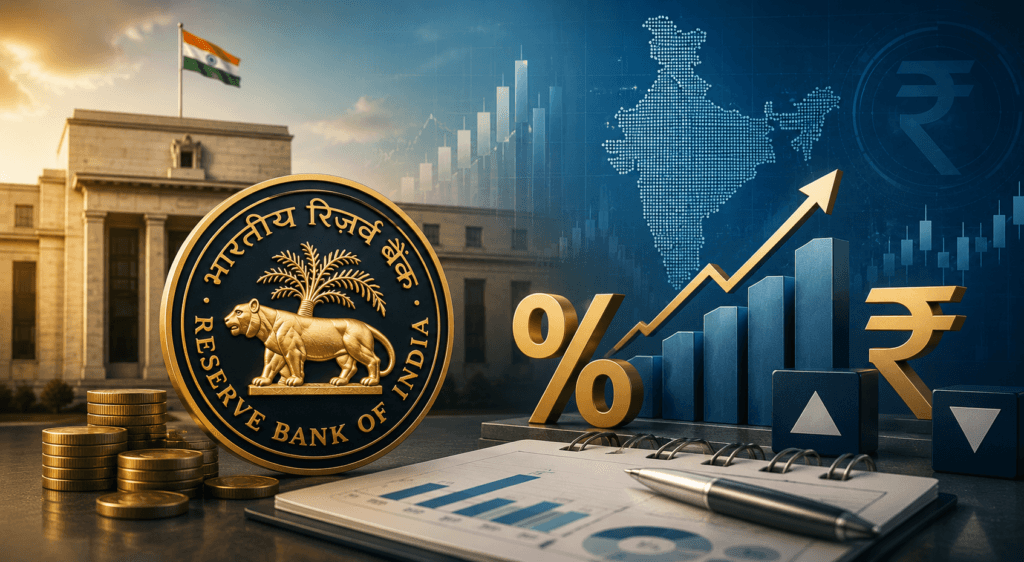
So yes, this rate touches your life directly. Your home loan EMI. Your car loan interest. Even the return on your fixed deposit. It is one of the most powerful levers in India’s economy.
In 2025, the RBI cut rates by a total of 125 basis points. From 6.50% down to 5.25%. That translated to roughly ₹3,000 in monthly savings on a ₹50 lakh, 20-year home loan. That is real money, and it shows just how much this rate matters.
Where Do Things Stand Right Now?
To understand June, you need to know what happened in April.
The MPC met from April 6–8, 2026. They looked at all the data. Inflation was rising but still within the RBI’s 2–6% comfort zone. GDP growth was revised down to 6.9% for FY ’27—partly due to the ongoing conflict in West Asia. Oil prices had climbed above $103 per barrel. The rupee had weakened sharply.
The decision? Keep the repo rate unchanged at 5.25%. Unanimous vote. Neutral stance maintained.
Why did they pause? The inflation shock was supply-driven—caused by oil prices and global conflict, not by people spending too much. A rate hike in that situation would hurt growth without fixing the root problem. A cut would risk letting inflation slip out of control. So they waited.
That is exactly what makes the June meeting so important. Two more months of data will either confirm that the pause was right—or push the RBI to act.
Key factors Shaping the June 2026 Decision
The RBI does not act on guesses. It watches specific signals. Here are the four biggest ones heading into June.
India’s CPI inflation was 3.4% in March 2026 — below the 4% target. But economists at ICRA and CareEdge project April inflation could cross 4%, driven by higher LPG costs, fuel prices, and monsoon uncertainty. The RBI’s own projection is 4.6% for full-year FY27. If inflation data for April–May comes in high, the case for a rate cut weakens. If it stays mild, a cut becomes more possible.
Also watch food prices—they have the biggest swing effect on India’s CPI, especially for rural households. El Niño conditions this year could push food prices up if the monsoon underperforms (IMD forecasts 92% of long-term average rainfall).
India imports about 85% of its oil. When crude prices stay high, everything from transport to manufacturing gets more expensive. In March 2026, crude averaged $103 per barrel. That number matters a lot for June.
Meanwhile, the US Federal Reserve has held rates at elevated levels. If the Fed cuts before June, global capital flows could ease pressure on the rupee. If they hold or hike, the RBI will be cautious about cutting—it could weaken the rupee further and make imports costlier.
The West Asia conflict remains unresolved. Any escalation could spike oil prices and derail India’s inflation outlook within weeks.
FY27 GDP growth is projected at 6.9% — solid, but lower than what was expected earlier. Domestic demand remains healthy. Manufacturing capacity utilization is improving. But exports face headwinds from the global slowdown. If growth data weakens before June, the pressure to cut rates to support the economy will increase.
In the RBI monetary policy June 2026 meeting, the MPC will weigh this balance carefully. A rate cut boosts growth but risks inflation. A hike controls inflation but can slow down an economy already navigating a global shock.
The rupee touched a record low near ₹95 to the dollar in late March 2026. Currency weakness pushes up import costs — and that feeds directly into inflation. A stable or recovering rupee gives the RBI more room to cut. A further fall increases the risk of imported inflation and limits options.
India’s forex reserves stood at $696.1 billion as of early April — roughly 11 months of import cover. That is a buffer. But it is not immunity.
Will the RBI Keep the Repo Rate Unchanged in June?
The honest answer is this is the most likely outcome, but it is not guaranteed.
Here is the case for staying put:
- Inflation is still below 4% as of March—within the comfort zone.
- The shock driving inflation is supply-side. Rate changes cannot fix an oil crisis.
- The economy is growing at a reasonable 6.9%—not urgent enough to force a cut.
- Markets would react badly to surprise moves. Predictability has value.
- The neutral stance gives the RBI flexibility to go either way without committing.
A pause is also the “safe” choice when there is genuine uncertainty. And right now, with the West Asia situation still fluid, that uncertainty is real.
Could the Rate Change—Hike or Cut?
Both remain possible depending on what the data shows before June 5.
A rate hike would happen if the April–May CPI crosses 5% and stays there or if crude oil spikes sharply and the rupee falls further. This is the least expected outcome right now, but the West Asia conflict keeps it on the table. A hike would push EMIs up and cool spending across the economy.
A rate cut is more plausible. If April–May inflation stays below 4% and growth signals weaken, a 25 basis point cut is possible. This would ease borrowing costs, lower EMIs on repo-linked loans, and support both household spending and business investment. Most market analysts lean toward this scenario as the next move—just not necessarily in June.
Mixed market sentiment is the honest summary. Some expect a cut in June; others say August or October. Very few expect a hike. Almost nobody expects the RBI to act dramatically without the data to back it up.
What This Means for You?
If you have a home loan, the rate hold means your EMI stays where it is. A cut would reduce it—a 25 bps cut saves roughly ₹750–₹1,500 per month depending on your loan size. A hike would push it up by a similar amount.
For investors, a rate cut is generally positive for the stock market — cheaper credit boosts company earnings. Bond yields would fall if a cut were expected, so bond prices rise. A hike does the opposite: equities get nervous, and yields climb.
For businesses, the rate hold gives predictability. Lower rates make expansion cheaper and working capital easier to manage. A hike raises costs across the board—especially for small businesses that rely heavily on credit.
For people with fixed deposits, the current rates may be worth locking in now. If a cut happens later in FY27, deposit rates will likely drift lower over time.
What should you do before the June announcement?
Here is what makes sense regardless of which way the RBI goes:
- If you have a floating-rate home loan, check whether your bank has passed on earlier cuts fully.
- Avoid taking big financial decisions—like prepaying a loan or locking a long FD—purely based on June speculation.
- If you are planning a new loan, compare repo-linked and fixed-rate options. Repo-linked loans benefit from cuts but carry rate-hike risk.
- Keep an eye on RBI announcements on June 5—the decision comes out that morning.
- When in doubt, speak to your financial advisor before making any major move.
Conclusion
June is shaping up to be a pivotal month. The data from April and May will tell the RBI which way to lean. If inflation stays tame, a cut is possible. If oil prices stay high and the rupee stays weak, a pause is more likely. A rate hike is the least expected outcome but cannot be completely ruled out.
What is clear is this — the RBI monetary policy June 2026 decision will not be made lightly. The MPC has consistently shown it weighs all the signals before moving. For the rest of us, the best move is to stay informed, review our finances, and not make panicked decisions based on speculation. Whatever the RBI decides, understanding why it happened is half the battle.
The announcement is on June 5, 2026. Mark your calendar.
Author: RSSPL News

Union Health Ministry Activates Precautionary Hantavirus Surveillance Following Cruise Ship Outbreak
Union Health Ministry Activates Precautionary Hantavirus Surveillance Following Cruise Ship Outbreak The Union Health Ministry has officially activated high-level surveillance […]
Suvendu Adhikari Set to Become West Bengal Chief Minister In a historic turning point for eastern Indian politics, Suvendu Adhikari […]

Suvendu Adhikari PA Shot Dead as Post Election Violence Grips West Bengal The post-election atmosphere in West Bengal has turned […]
PM Modi Calls on Indians to Cut Fuel Use and Avoid Excess Gold Buying In a decisive move to shield […]

NEET-UG 2026 Cancelled: Nationwide Outrage as Nashik Police Arrest Key Accused The NEET-UG 2026 examination has been officially cancelled following […]

Is Your Family Eligible for Free Treatment Under Ayushman Bharat PM-JAY? Healthcare expenses can become a major financial burden for […]