

How Cyclone Narelle Turned the Australian Sky Blood Red?
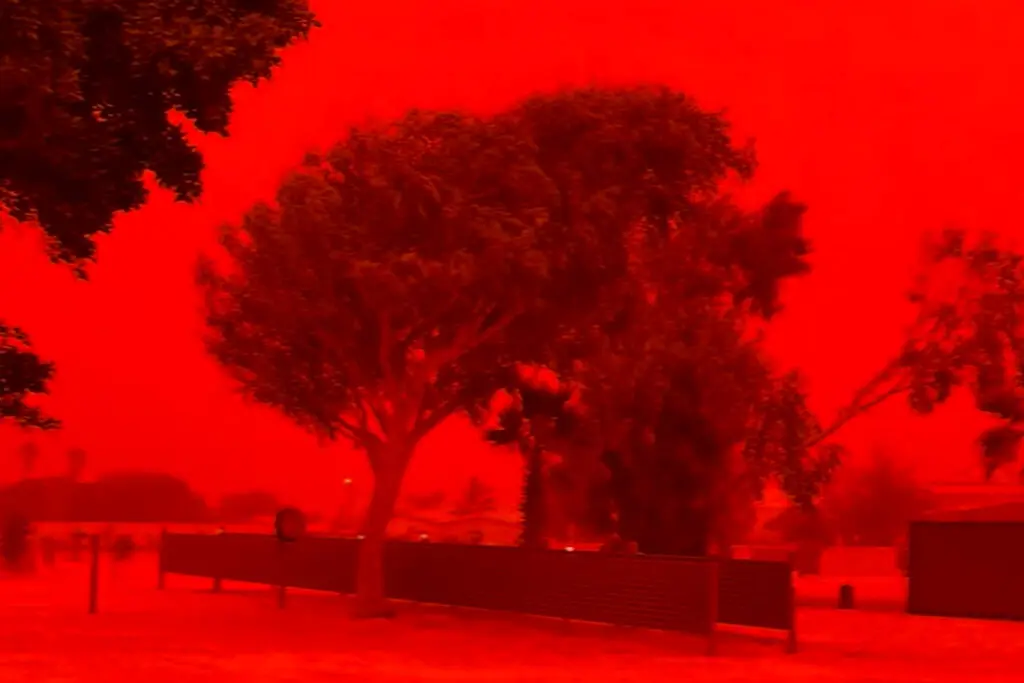
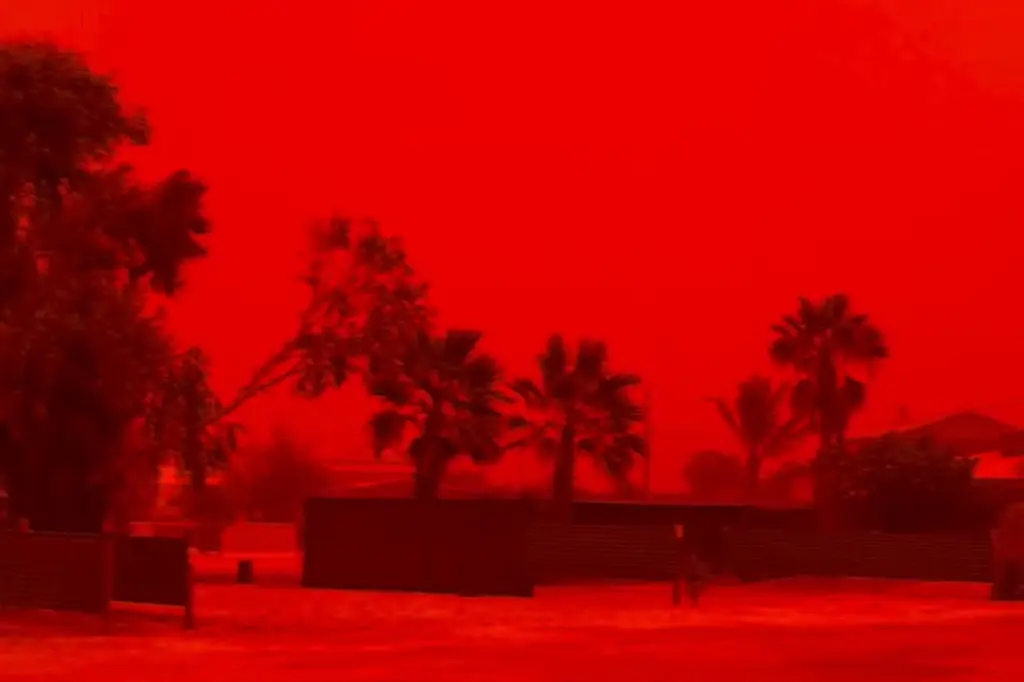
The residents of Shark Bay, Western Australia, awoke this past Friday to a scene that looked more like the surface of Mars than a coastal tourist town. As Tropical Cyclone Narelle approached the coastline, the sky transformed into a deep, apocalyptic crimson, blotted out by a massive wall of iron-rich dust.
This rare atmospheric event, captured in viral footage from the Shark Bay Caravan Park in Denham, has stunned social media users globally. According to the Bureau of Meteorology (BOM), the phenomenon was the result of a “perfect storm” of high-velocity winds, iron-infused soil, and specific light-scattering physics known as Mie scattering.
Table of Contents
ToggleKey Incident Facts and Timeline
To understand how this spectacular visual event unfolded, here are the essential details regarding the Tropical Cyclone Narelle red sky phenomenon:
- Date of Event: Friday, March 27, 2026.
- Primary Location: Shark Bay and Denham, Western Australia (roughly 900km north of Perth).
- The Catalyst: Tropical Cyclone Narelle, which reached Category 4 intensity.
- Atmospheric Cause: A pre-storm dust surge lifting iron oxide (rust) from the Pilbara region.
- Current Status: Narelle has since weakened to a tropical low, but cleanup from the dust and wind continues.

What's the Science Behind the Blood Red Horizon?
Many viewers online initially suspected the viral videos were edited, but meteorologists have confirmed the authenticity of the “no-filter” footage. The intense color is caused by a combination of the landscape’s unique chemistry and the way light interacts with suspended particles.
Western Australia is famous for its “rust-red” earth, particularly in the Pilbara region, which is rich in iron oxide (hematite). As Narelle’s outer bands “whipped” the landscape, they vacuumed up massive quantities of this fine, rust-colored dust, pushing it hundreds of kilometers ahead of the storm’s center.
When sunlight hits these large iron oxide particles, a process called Mie scattering occurs. Unlike the nitrogen and oxygen molecules that usually scatter blue light to give us a blue sky, these larger dust particles block shorter wavelengths (blue and green) and allow only the longest wavelengths—the deep reds—to pass through.
Narelle Makes History with a Rare Triple Strike
Beyond the visual spectacle, Tropical Cyclone Narelle is carving its name into the record books for its unusual and destructive path. It has become the first storm system in over 20 years to make landfall in three separate Australian jurisdictions.
- Queensland: First landfall on the Cape York Peninsula on March 20 as a high-end Category 4.
- Northern Territory: Tracked across the Top End as a Category 3 system.
- Western Australia: Re-intensified over the Indian Ocean before slamming into the WA coast near Exmouth and Shark Bay.
This “triple-strike” trajectory is historically rare, with the last similar precursors being Cyclone Ingrid in 2005 and Cyclone Steve in 2000. Climate scientists suggest that record-high ocean temperatures in the Coral Sea likely fueled Narelle’s early intensification and endurance.

Impact on Industry and Infrastructure
The storm wasn’t just a light show; it brought significant disruption to Australia’s critical infrastructure. The high winds and visibility-clogging dust forced the closure of major operations in the Pilbara, the heart of the nation’s iron ore industry.
- LNG Disruptions: Energy giants Chevron and Woodside reported disruptions at the Gorgon and Wheatstone plants, accounting for roughly 5% of global LNG capacity.
- Power Outages: Thousands of residents across the Gascoyne and Pilbara regions were left without power as winds gusting up to 200 km/h downed lines and damaged roofs.
- Port Closures: Rio Tinto suspended ship loading at several terminals, including Cape Lambert and Parker Point, as a safety precaution.
Environmental and Health Implications
While the red sky is a photographer’s dream, it presents serious challenges for local health and the environment. The “apocalyptic” dust storm reduced visibility to near-zero in Denham, making road travel extremely hazardous.
Health authorities have issued warnings for residents with respiratory conditions, as the fine mineral dust can cause severe irritation. Furthermore, scientists are now monitoring how this iron-rich dust settles into the Indian Ocean. While iron can trigger beneficial nutrient cycles for marine life, such massive deposits can also lead to unpredictable algae blooms that disrupt the local ecosystem.
A Legacy that Remains Beyond the Storm
As Narelle transitions into a subtropical low, the images of the blood-red sky remain as a haunting reminder of nature’s power. For many, 2026 is already proving to be a year of extreme weather, with Narelle’s Mars-like hue serving as a visual “final warning” of the intensifying climate patterns affecting the continent.
The residents of Shark Bay are now left with the daunting task of cleaning the “rust” from their homes and vehicles. However, they also walk away with the memory of witnessing one of the most rare and beautiful—if not eerie—meteorological displays in Australian history.
Sonia Gandhi Hospitalized in Delhi for Systemic Infection and Respiratory Health Concerns Congress Parliamentary Party Chairperson Sonia Gandhi was admitted […]

Your Money Your Right: RBI, SEBI and IRDAI Join Forces to Return ₹73,241 Crore in Unclaimed Assets
RBI, SEBI & IRDAI Joint Mission: The New Way to Get Your “Lost Assets” Back In a massive push for […]

100 Districts, One Mission: How PM Dhan-Dhaanya Krishi Yojana (DDKY) Transforming Indian Farming?
The Ministry of Agriculture and Farmers Welfare has launched the Prime Minister Dhan-Dhaanya Krishi Yojana (DDKY) to spark a rural transformation across …
How Cyclone Narelle Turned the Australian Sky Blood Red?
How Cyclone Narelle Turned the Australian Sky Blood Red? The residents of Shark Bay, Western Australia, awoke this past Friday […]

Microsoft HR Overhaul: Chief People Officer Signals End of “Stability Era” In a bold internal move, Microsoft’s Chief People Officer, […]

Vijay Mallya Era Ends: Relinquishes All Ties to RCB as Global Consortium Takes Over
Vijay Mallya Era Ends: Relinquishes All Ties to RCB as Global Consortium Takes Over The final chapter of Vijay Mallya’s […]


