
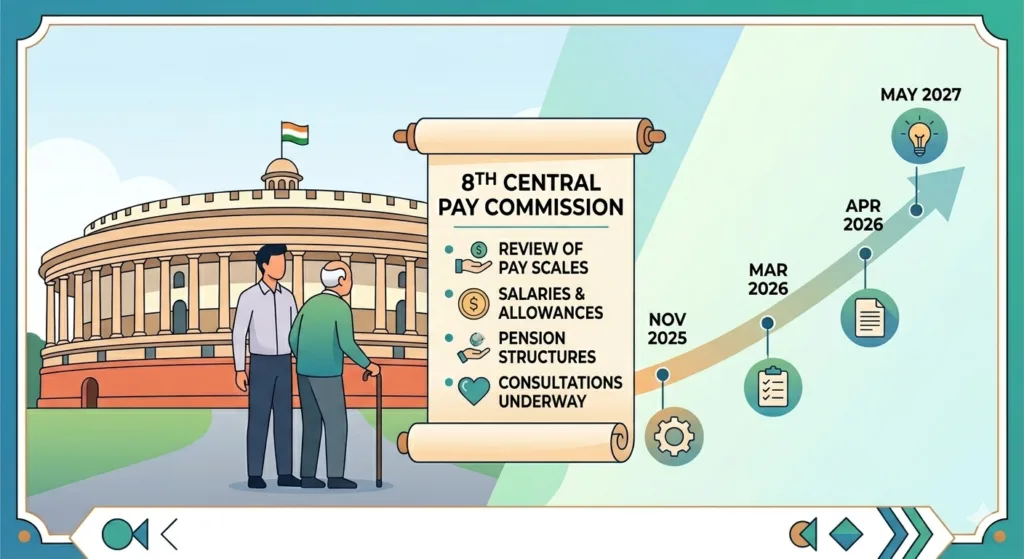

8th Pay Commission Roadmap Revealed: Government Details Mandate and Timeline in Parliament

The Central Government has officially shared the comprehensive roadmap for the 8th Central Pay Commission (CPC), providing much-needed clarity for millions of employees and pensioners. In a formal session in the Lok Sabha on Tuesday, the Ministry of Finance confirmed that the commission is actively examining a total overhaul of the current pay structures.

This update comes as a major milestone for the administrative framework of the country. The government’s response follows months of speculation regarding the constitution of the panel and the specific areas it will investigate. With the formal resolution now in place, the path is clear for a detailed review of how central silver-service members are compensated in the coming years.

Official Constitution and Leadership of the 8th CPC

  • Formal Notification The Centre notified a resolution dated November 3, 2025, officially constituting the 8th CPC and appointing its core leadership team.
  • Key Appointments The commission is headed by Chairperson Ranjana Prakash Desai, with Pulak Ghosh serving as a part-time member and Pankaj Jain as the member-secretary.
  • Administrative Setup The commission has already established its primary office in New Delhi and is currently recruiting for several key administrative positions, including Directors and Under Secretaries.
  • Operational Status The panel has officially begun its mandate, putting in place the necessary legal and logistical framework to handle thousands of representations.
8th Pay Commission

Core Mandate Covering Pay and Pension Scales

The primary focus of the 8th CPC is to conduct a granular review of the existing financial benefits provided to central government staff. Minister of State for Finance, Pankaj Chaudhary, clarified that no stone will be left unturned in this evaluation.

The review specifically targets four pillars of compensation: basic pay scales, monthly salaries, various allowances (such as HRA and DA), and the overarching pension structures. The goal is to align these figures with the current economic reality and inflation trends, ensuring a fair standard of living for both serving and retired personnel.

Timeline for Report Submission and Implementation

  • Eighteen Month Window The government has mandated the 8th CPC to submit its final recommendations within 18 months from the date of its constitution.
  • Final Decision Authority Once the report is submitted, the Union Cabinet will review the suggestions before taking a final decision on acceptance.
  • Budgetary Impact The Finance Ministry stated that the specific fiscal impact on the Union Budget can only be quantified once the government officially accepts the recommendations.
  • Expected Deployment While the report is being drafted, the administrative machinery is preparing for a potential rollout following the mandatory review period.

The Consultative Process and Stakeholder Engagement

The commission is adopting a highly transparent and inclusive approach by inviting feedback from a wide range of stakeholders. This ensures that the final recommendations reflect the ground reality of employees across different sectors.

Stakeholder GroupMethod of SubmissionDeadline
Employees & PensionersOnline Memoranda (Official Website)April 30, 2026
Ministries & State GovtsStructured Questionnaire (MyGov Portal)March 31, 2026
Judicial OfficersFormal RepresentationsApril 30, 2026
Academia & ResearchersStructured QuestionnaireMarch 31, 2026
A Digital Approach to Employee Feedback
  • MyGov Integration In a first-of-its-kind move, the panel has hosted a 18-question questionnaire on the MyGov portal to gather direct feedback from the public and staff.
  • Online Memoranda A structured digital format has been provided on the commission’s official website for submitting detailed representations or grievances.
  • Inclusive Reach The feedback loop extends beyond just central staff to include Union Territories, regulatory bodies, and officers of various Indian courts.
  • Transparent Mechanism This digital-first strategy is intended to minimize paperwork and allow for a faster analysis of the thousands of expected responses.
What Central Employees Should Do Next

For those currently in service or receiving a pension, the window for influence is currently open. The commission has urged all associations and individual employees to utilize the online portals to voice their concerns regarding pay anomalies or allowance structures.

With the questionnaire deadline of March 31, 2026, and the memoranda deadline of April 30, 2026, the next two months are critical for ensuring that specific departmental issues are recognized by the panel. This consultative phase is the only opportunity for employees to provide direct input before the commission enters its internal deliberation stage.

RCB New Owners 2026

Vijay Mallya Era Ends: Relinquishes All Ties to RCB as Global Consortium Takes Over The final chapter of Vijay Mallya’s […]

Samsung Galaxy A57 5G

Samsung Unleashes the Slimmest and Fastest Galaxy A57 5G and A37 5G Ever Samsung Electronics has officially pulled back the […]
Unclaimed Deposits

RBI, SEBI & IRDAI Joint Mission: The New Way to Get Your “Lost Assets” Back In a massive push for […]

Sonia Gandhi

Sonia Gandhi Hospitalized in Delhi for Systemic Infection and Respiratory Health Concerns Congress Parliamentary Party Chairperson Sonia Gandhi was admitted […]

LPG Booking

Government Refutes Rumors of Change in LPG Refill Booking Timeline The Government of India has officially dismissed widespread reports and […]

US-Iran Peace Talks

Diplomatic Rift – Israel Envoy Denies Knowledge of US-Iran Peace Talk Overtures In a significant break from the White House […]

Scroll to Top